Crossy Road
- 4.5
- Rating
- 100.00M
- Installs
- Free
- Price

 Analysis by App-foxy
Crossy Road is the kind of action game I can understand within seconds and still return to much later. I tap to move a small character across roads, tracks, rivers, and other hazards, trying to travel as far as possible before a vehicle, train, current, or mistimed jump ends the run. That simplicity is the reason it works so well in short sessions, but it is also the question that matters after the first week: does it offer enough variety to deserve a permanent place on a phone?
My answer is mostly yes, with an important qualification. This is not a deep action game built around a campaign, complex controls, or a long story. It is a compact arcade game from HIPSTER WHALE, designed around repeated attempts and gradual improvement. The free entry point makes it easy to try, and the Everyone rating makes it suitable for a broad audience. I think it earns lasting space for players who enjoy chasing better runs, collecting characters, and learning patterns. People looking for a substantial adventure will probably move on quickly.
Why the first week feels so inviting
The opening appeal comes from the control scheme. Tapping advances the character, while swiping changes direction. There is no virtual joystick to cover the screen and no complicated button layout to memorize. I can start a run while waiting for a coffee, play for a minute, and put the phone away without needing to remember a long sequence of objectives.
You May Also Like

 Blood Strike: 2.5 Anniversary
Blood Strike’s Loadouts Turn Every Drop Into a Tactical Gamble
A close look at Blood Strike’s custom loadouts: how fast access to signature weapons reshapes its battle royale rhythm, rewards preparation, and narrows the gap between fights.

 Pandora - Music & Podcasts
Pandora’s Music Is Easy to Start, but Harder to Recover
Pandora’s strength is its low-effort path from a seed to a station. Its weak spot is how much confidence it asks you to place in connection, setup, and quiet recovery.

 8 Ball Pool
 Is Built on Rivalries, Rematches, and Routine
A close look at the rivalries, rematches, shared routines, and unanswered safety questions that turn a quick pool match into a persistent mobile community.

 Samsung Music
’s Quiet Strength Is Playing What You Already Own
Its reach comes less from spectacle than from dependable access to a personal library. That simplicity is both the app’s strongest retention engine and its ceiling.

 AccuWeather: Weather Radar
AccuWeather Review: A Quick, Clear Forecast for Everyday Decisions
For everyday plans, the best forecast is the one you can understand quickly. AccuWeather makes rain timing, radar, and local conditions easy to act on, with a few trade-offs.

 Hill Climb Racing
Why Hill Climb Racing Still Turns Crashes Into One More Run
A tiny car, a bumpy hill and one more upgrade: Hill Climb Racing keeps resurfacing because its simple chaos makes every near-miss feel personal.
More From Our News Desk



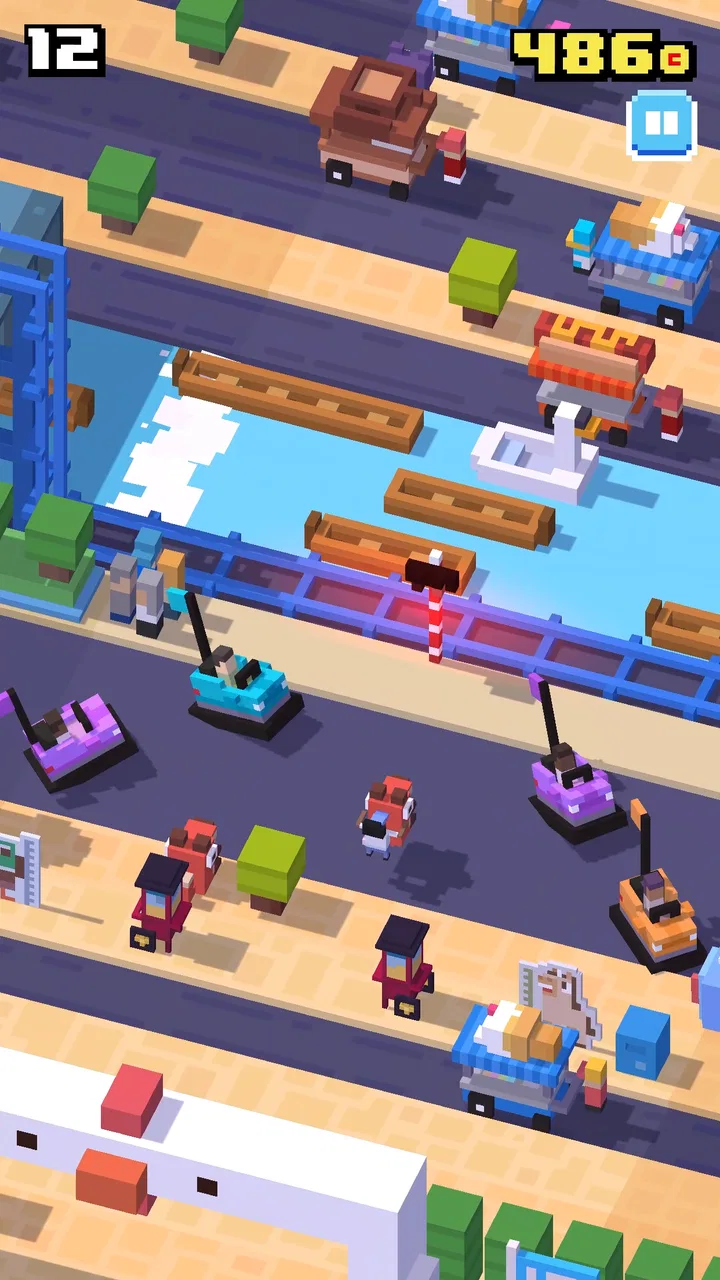
That immediate clarity is supported by the visual style. The blocky characters and environments are bright, readable, and expressive without relying on realistic detail. Traffic lanes, railway lines, water, grass, and gaps are easy to distinguish at a glance. When the screen becomes busy, that visual simplicity is practical rather than merely decorative: I can focus on timing instead of searching for the playable route.
The first few sessions also reveal a satisfying tension between speed and caution. Moving forward usually feels safer than hesitating forever, because the camera and the level continue to pressure me. At the same time, rushing into the next lane is often worse than waiting for a usable opening. The best early lesson is to stop treating every tap as progress. Sometimes the correct move is a short pause while watching the traffic pattern.
A typical everyday session is easy to imagine. I might have a few minutes before an appointment, open the game, complete several attempts, and close it after one run that feels almost successful. The short format does not punish interruption. There is no need to reserve a quiet evening or commit to a long match, which gives it an advantage over action games that only feel worthwhile after extended play.
What surprised me during the first week was how quickly the game becomes a test of visual rhythm. Cars and trains are not just obstacles; they create repeating openings that I need to read while the screen scrolls. Rivers add another kind of timing, since safe movement depends on following available platforms rather than simply waiting for a clear lane. The challenge is accessible, but the decision-making is more active than the cute presentation suggests.
Character collecting adds a second reason to keep playing. New characters change the look and feel of the run, and some are tied to playful themes that make the roster enjoyable to explore. I would not call the collection system a replacement for a campaign, but it gives successful sessions a purpose beyond a single score. For a player who enjoys completion goals, that can make the first week feel more substantial.
The game is free to start, which matters here because the basic loop is easy to sample without a purchase. In-app items range from $0.49 to $29.99 per item, so I would advise deciding early whether collecting is a casual extra or a spending temptation. I found the most enjoyable approach was to treat purchases as optional decoration rather than as a requirement for learning the game.
Small habits that improve early runs
My most useful early habit was to look slightly ahead instead of staring only at the character. The next safe landing often matters more than the obstacle directly in front of me. I also learned to avoid frantic repeated tapping near a road: rapid inputs can turn a manageable opening into an accidental jump into danger.
Another practical tip is to use the edges of the screen carefully. Staying too close to one side can reduce the number of escape options when the level shifts, while moving toward the center without checking the next hazard can be equally risky. I try to keep a mental route open rather than chasing every possible forward step.
When I am playing with a child or a less experienced player, the game works well as a shared observation exercise. Instead of grabbing the phone and making every decision, I can ask which lane looks safest and let the player explain the choice. The controls are simple enough for beginners, but the need to judge timing gives the game more value than a purely passive distraction.
What remains after the novelty fades
After the bright first impression settles, the lasting value depends on whether repeated attempts feel meaningful to you. Crossy Road does not transform into a different type of game after extended use. Its core remains the same: move, read hazards, survive longer, and try again. That consistency is a strength for arcade fans and a limitation for anyone waiting for new layers of strategy.
I continue to find value in the short-run structure because improvement is easy to feel. A failed attempt can teach me that I moved too early, ignored a changing pattern, or spent too long waiting for a perfect opening. The next run gives me an immediate chance to apply that lesson. This feedback loop is more durable than the novelty of the characters, although it requires patience with repetition.
The collection side helps maintain interest from month to month, especially if I enjoy setting small personal targets. I can focus on reaching a better distance, unlocking another character, or simply completing a few clean runs without careless mistakes. These goals are modest, but they fit the game’s scale. I do not need a large block of free time to make progress.
There is also value in its social, observational quality even when I am not competing directly. The game is easy to hand to another person because the controls can be explained in a sentence. Watching someone else play exposes different habits: some players rush, others freeze, and experienced players often make fewer movements than beginners expect. That makes it a useful casual game for families or friends sharing a device.
Still, I would not recommend treating it as a complete replacement for a richer action title. Compared with an action game built around levels, equipment, missions, or a narrative campaign, this one offers less structural progression. Compared with a traditional endless runner, its emphasis on crossing and timing gives it a distinctive identity, but the repeated format can feel narrower once the surprise of new obstacles and characters wears off.
The current version is 7.10.0, and the fact that the game has remained available across many years supports its role as a familiar pick-up-and-play title. Its release on January 7, 2015, also explains why the format feels established rather than experimental. I see that maturity as a benefit for stability of concept, but not as proof that every player will find endless freshness.
Who gets the most recurring value
I think the strongest audience is someone who likes arcade games with a clear personal skill curve. If you enjoy trying to beat your own best performance, learning visual patterns, and collecting playful characters, the game can remain useful as a small daily habit. It is particularly good for people who dislike tutorials, lengthy dialogue, or complicated progression screens.
It also suits players who want an action game that can be stopped at almost any moment. A commute, a short break, or a few minutes before bed can all accommodate a run. The low commitment makes it easier to revisit than games that require a team, a stable connection with other players, or a long uninterrupted session.
I would be more cautious recommending it to someone who needs a strong sense of completion. If your idea of progress is finishing chapters, defeating named bosses, or unlocking a final ending, the endless structure may feel empty. Likewise, players who dislike repeating a similar challenge after failure may find the central loop tiring rather than motivating.
Maintenance, friction, and the reasons fatigue appears
One of the game’s advantages is that it asks little maintenance from the player. I do not need to manage a complicated inventory, remember a large set of abilities, or maintain a daily routine to understand what I am doing. Returning after a long break is easy because the essential controls and objective come back immediately.
That low maintenance does not mean there is no friction. The game’s simplicity places a lot of weight on the quality of each attempt. A run can end because of one rushed tap, and when I am tired, that can feel less like a fair challenge and more like a reminder to stop playing. The same clarity that makes it accessible also leaves little else to distract me from a mistake.
Collecting can create a different kind of maintenance burden. Once I begin caring about the roster, I may feel pressure to keep playing even when I am no longer enjoying the run itself. My solution is to separate the two goals: I play for the movement and timing first, and I regard characters as a bonus. That keeps the collection from turning a relaxing game into a checklist.
Optional purchases deserve similar discipline. Because the game is free and includes items priced from $0.49 up to $29.99, I would not open it with an undefined idea of “seeing what happens.” A simple personal rule helps: spend only if a particular character or collectible genuinely adds enjoyment, not because a frustrating run made me impatient. The game is at its best when purchases remain secondary to skill.
Fatigue usually arrives in three forms. The first is repetition: roads, rivers, and tracks can remain entertaining, but the basic activity does not change into a deeper system. The second is emotional irritation after a careless failure, especially when I know I could have waited. The third is collection fatigue, when the desire to unlock more items becomes stronger than the pleasure of playing.
There is a useful way to manage all three. I prefer short sessions with a specific purpose rather than endless attempts made automatically. I might play until I improve a personal result, practice calmer movement, or enjoy a few runs with a favorite character. Once that purpose is met, closing the game preserves its appeal better than forcing another half hour.
The game is also not the right choice when I want a calm, low-attention experience. Although the controls are simple, the hazards demand concentration. A podcast, conversation, or crowded commute can make the timing harder, and the resulting failures may feel unfair even when they are caused by divided attention. For passive relaxation, a puzzle or slower simulation game would be a better fit.
How it compares with familiar alternatives
Against a conventional endless runner, Crossy Road feels more deliberate. Many runners encourage continuous forward movement and rapid lane changes, while this game gives me more reasons to pause, inspect the next opening, and choose a safer route. That makes it approachable for players who find constant speed overwhelming, though it can feel less exciting to people who want uninterrupted momentum.
Against a level-based action game, it wins on convenience and loses on narrative satisfaction. I can begin instantly and stop without losing a story thread, but I do not receive the same sense of place or accomplishment that comes from clearing a designed stage. If I want a game to occupy an evening, I would choose the level-based option. If I want a quick test of timing, this is more practical.
Against a collection-focused casual game, its strongest asset is that the collectibles are attached to a skill loop rather than being the entire reason to return. That said, players who mainly enjoy organizing, decorating, or building may find the action too demanding. The right comparison depends on whether you want your progress to come from better decisions or from expanding a personal catalogue.
On Android, the game requires at least version 9 of the operating system. That makes it relevant to many users with reasonably current devices, while anyone using an older phone should check compatibility before planning around it. I also appreciate that the game’s visual language remains readable on a small screen, although a larger display can make judging distant traffic more comfortable.
My long-term verdict
Crossy Road earns lasting space on my phone when I use it as an arcade habit rather than expecting it to become a full adventure. Its best qualities are immediate controls, readable hazards, short sessions, and a skill curve that rewards calmer decisions. The character collection gives returning players another reason to care, while the free starting point makes the commitment small.
Its limitations are just as clear. The central loop remains repetitive, mistakes can become irritating, and collecting may encourage unnecessary spending if I approach it without a boundary. Players who need story, elaborate missions, or major changes over time should choose another action game. Even fans may need to take breaks so the familiar rhythm does not turn into background tapping.
The game has reached a broad audience, with over 100 million installs, around 4.6 million ratings, and a 4.5 average. Those figures fit my impression that it is unusually easy to recommend as a casual arcade game, but popularity does not remove the need to match it with the right expectations. Its Everyone rating makes it broadly approachable, yet younger players may still benefit from guidance around optional purchases and session length.
For me, the deciding test is simple: after the novelty of the characters fades, do I still enjoy reading the next safe move? When the answer is yes, the game remains a dependable companion for small breaks. When the answer becomes no, there is no campaign demanding that I continue, and moving on is perfectly reasonable.
My recommendation is to try it if you want a free, quick action game built around timing and personal improvement. Keep sessions purposeful, treat purchases as optional, and do not mistake the collection for a substitute for deeper progression. Used that way, this compact hopper can keep earning a place in a regular rotation long after the first colorful runs have lost their surprise.
FAQs for Crossy Road
01What is the objective of Crossy Road?
Crossy Road is an endless arcade hopper where your main objective is to guide your character across roads, rivers, and train tracks without getting hit. The game is all about timing and precision, as you dodge traffic, jump logs, and try to get as far as possible to achieve high scores.
02Is Crossy Road free to play?
Yes, Crossy Road is free to download and play on both Android and iOS platforms. However, there are in-app purchases available, which allow players to buy new characters and other items. These purchases are optional and not necessary to enjoy or progress in the game.
03What type of characters can I unlock in Crossy Road?
Crossy Road features a wide variety of characters, each with its own unique appearance and animations. You can unlock animals, people, and even mythical creatures. Characters can be unlocked randomly using coins collected in the game or purchased directly. Some characters also offer special abilities or themes.
04How can I earn coins in Crossy Road?
Coins in Crossy Road are earned by collecting them during gameplay or by watching optional video ads. You can use these coins to unlock new characters through the in-game prize machine. Consistent play and strategic moves help gather more coins, enhancing your ability to unlock diverse characters.
05Does Crossy Road require an internet connection?
Crossy Road can be played offline, making it great for on-the-go entertainment. However, an internet connection is needed for certain features, such as watching ads to earn coins or accessing leaderboard features to compare scores with friends online. Offline play is still fully enjoyable without these elements.
Pros
- Simple and addictive gameplay.
- Colorful and engaging graphics.
- Variety of characters to unlock.
- Smooth performance on most devices.
- Regular updates keep it fresh.
Cons
- Can become repetitive over time.
- In-app purchases can be tempting.
- Occasional ads can interrupt play.
- Some characters are hard to unlock.
- Limited depth for advanced gamers.

Crossy Road
Gallery